What this covers
|
Two products solve the same problem from opposite directions. A wall-mounted drop-leaf desk hinges up against the wall when the working day ends. A folding desk collapses and goes somewhere else entirely.
Both claim to give a room its floor back. They do, and the resemblance ends there. The trade-offs are different enough that the right answer is usually obvious once the right question is asked, and the right question is almost never about the desktop.
What Each One Actually Returns
Floor space returned is measured in square feet, not inches of desk width. That sounds obvious and it is the distinction most comparisons skip.
A wall-mounted desk folded up still occupies the wall. Its depth when closed is typically a few inches, so the floor underneath comes back but the wall does not. Anything that was going to live against that wall now cannot, permanently, whether the desk is open or shut.
A folding desk that rolls away returns both. The floor and the wall are free, and the space the desk occupies is wherever you put it, which is usually somewhere that was already dead space: under a bed, behind a door, in a closet.
The gap between those two outcomes is small in a room with spare walls and large in a room without any.
Installation Is the Dividing Line
This is where the two diverge in a way that cannot be negotiated.
A wall-mounted desk transfers its load into wall anchors. Everything on that desktop, plus the desktop, plus whatever force somebody applies leaning on it, ends up in a handful of fixings in the wall.
A stud is a vertical framing member inside a wall. Fixings into studs carry real load. Drywall anchors carry less load than anchors fixed into studs, and a wall-mounted desk fastened into drywall alone is a desk with a defined failure mode. Studs are generally spaced at a fixed interval, which means the desk goes where the studs are, not where the room would prefer it.
A folding desk transfers its load into its own frame. No wall involvement at all. The desk is self-supporting by design, which is why it can stand in the middle of a room, next to a window, or facing whichever direction suits the light that day.
Wall mounted | Folding and rolling | |
Load path | Wall anchors into studs | Own frame into feet or casters |
Install time | Locating studs, drilling, leveling | Unbox |
Tools needed | Stud finder, drill, level | Usually none |
Position | Fixed at install | Anywhere, any day |
Removal | Leaves anchor holes to patch | Lift and carry |
Height adjustable | Rare; fixed at install height | Common |
The Constraint That Removes One Option
Renters usually cannot drill into walls without permission. Depending on the lease that can mean written approval, a deposit deduction at move-out, or a flat prohibition.
A wall-mounted desk leaves anchor holes when removed. Patching and repainting is not difficult, but it is a move-out task with a cost attached, and it has to be done to a standard somebody else judges.
For a large share of the people who most need a dual-purpose room, this single constraint decides the comparison before any of the other factors are weighed. Anybody comparing foldable desks against a wall-mounted option in a rented apartment is often comparing one real option against one that requires a conversation with a landlord.
Height Adjustment Is Mostly a One-Sided Feature
Wall-mounted desks are usually fixed at whatever height they were installed at. That is a consequence of the mounting, not an oversight. A hinge line set into the wall is a hinge line, and moving it means drilling again.
Some models are installed at standing height and used with a stool. Some are installed at seated height. Very few do both, and the ones that do tend to be a fixed shelf at standing height plus a separate seated surface, which is two pieces of furniture described as one.
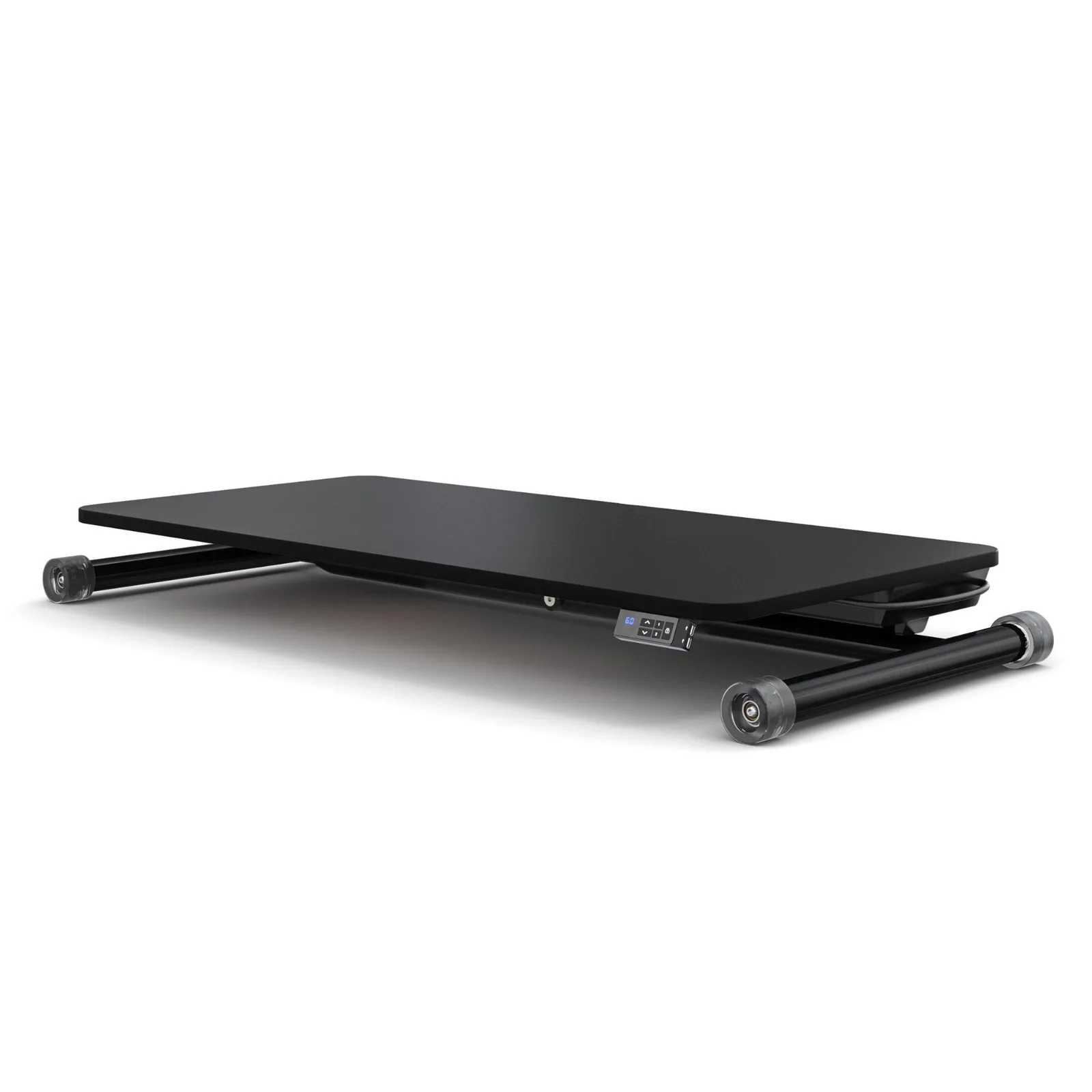
Self-supporting folding desks carry the adjustment mechanism inside the frame, so the range travels with them. That is why this half of the category is where the electric sit-stand designs are, and why the specifications quote a range rather than a height. A desk quoting six inches to forty-eight inches is describing a mechanism that covers floor sitting, chair sitting and standing without being re-installed for any of them.
Setup Time Compounds
A single fold or unfold takes seconds either way. That is the wrong unit.
Setup time compounds across a working year. Two transitions a day, five days a week, is roughly 500 transitions in a year. A process that takes thirty seconds costs about four hours over that period. A process that takes three minutes, because cables have to be reconnected and a monitor lifted on and off, costs about twenty-five.
The real cost is not the hours, it is what the friction does to behavior. A setup that is genuinely fast gets used. A setup that takes three minutes gets left up, which converts a stowable desk into a permanent one and undoes the entire reason for buying it.
Four things decide which end of that range a given setup lands in, and they apply to both designs.
The variable | Fast version | Slow version |
The monitor | Stays clamped to an arm on the desk | Lifted off and put somewhere every time |
Power | One cable from a strip on the frame | Five cables to a strip on the floor |
The surface | Folds with items still on it, or clears in one sweep | Has to be emptied before anything moves |
The destination | Two steps away, in the same room | Another room, through a doorway |
The last row gets underrated. A folding desk stored in a closet down the hall is a desk with a commute, and the commute is what people stop doing first.
Wall-mounted desks have an advantage on the first three and no answer at all to the fourth, because there is no destination to travel to. That is a genuine point in their favor and it is the reason a fixed drop-leaf in the right room can beat a better desk in the wrong one. The teardown is a single motion and nothing is carried anywhere.
What Happens When the Room Changes
Rooms change. People move furniture, swap bedrooms, take a new apartment, or discover the light is better on the other side.
A wall-mounted desk occupies one fixed position permanently. Changing it means uninstalling, patching, and reinstalling somewhere the studs allow. In practice the desk usually stays and the rest of the room works around it.
A rolling desk can serve more than one room. The same desk works in the bedroom in winter when that room is warmest and by the window in summer. That flexibility has no equivalent on the wall-mounted side, and it is the reason the folding option tends to survive a house move intact while the mounted one is often left behind.
The Honest Case for Each
Wall-mounted wins on three things and they are real. It is usually cheaper. It has no mechanism to wear out, because a hinge and a wall plate is about as simple as furniture gets. And it takes up no floor space at all when closed, not even the few square feet a folded desk needs wherever it is stored.
If somebody owns their home, has a wall they are happy to commit permanently, works at one height, and wants the cheapest durable answer, the wall-mounted desk is the better purchase and the comparison should end there.
Folding wins where any of those is untrue. Renting, wanting height adjustment, working in more than one spot, or expecting the room to change within a few years all point the same direction.
What Neither One Fixes
Both approaches return floor space. Neither creates working space.
A desk that is too shallow to hold a monitor at a comfortable viewing distance is too shallow in both designs. A room without a power outlet near the working position has that problem whichever desk is in it. Storage for the things that were on the desk has to go somewhere, and "somewhere" is a decision that neither product makes for you.
The stowage question is worth answering carefully. It is also the second question. The first one is still whether the desk is a good desk while you are working at it, and a comparison that starts with how the desk disappears has quietly assumed the answer.
A useful way to settle it is to imagine the desk permanently open, ignore the folding entirely, and ask whether you would buy it on those terms. If the answer is no, the fold is being asked to compensate for a desk that was not good enough, and it will not manage it. If the answer is yes, the fold is a genuine addition and the comparison can proceed on the terms above.