Pest control digital marketing has changed. It used to be about having the nicest logo or the most prominent billboard. Today, it is simply about who shows up first on a map and who answers the phone fastest. Because pest issues cause immediate panic, customers aren't browsing; they are reacting. Success in 2025 isn't about "brand awareness"—it's about "speed-to-lead" and dominating the top three spots on Google Maps.
Think about the last time a homeowner called you. It likely wasn't because they spent weeks researching local entomology. It was because they found termites in the garage or saw a rat in the kitchen. In that moment, they didn't care about your company history. They cared about one thing: "Can you get here today?"
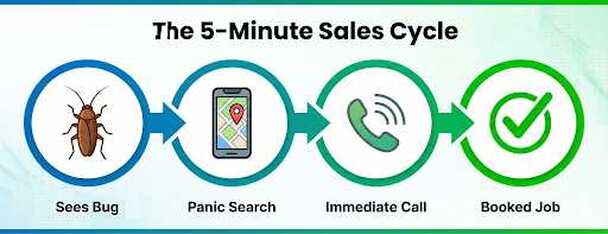
This "panic purchase" behavior is forcing a massive correction in how pest control companies spend their marketing budget. The old way of building a long-term brand is too slow. The new way is entirely about capturing the customer in the five-minute window between spotting a bug and dialing a number. If your business isn't built to win that five-minute window, you are losing jobs to competitors who are, regardless of how good your technicians are.
The "Panic Call": How Your Customers Actually Buy
To understand where your marketing money should go, you have to look at how your customer acts. Recent industry discussions have highlighted a simple truth: pest control is a "grudge purchase." Nobody wants to buy it. They buy it because they are scared, disgusted, or worried about property damage.
When a customer is in this state, they have zero patience. They don't want to read a long "About Us" page. They don't want to fill out a "Contact Us" form and wait 24 hours for an email. They want a phone number, and they want it now. This compressed timeline means your fancy website features matter much less than your ability to be found instantly.
If you have a great website but you don't show up in the "Near Me' map results when a homeowner searches on their iPhone, you don't exist. This highlights how crucial local visibility is for your business's success and growth.
The Three Pillars of Modern Pest Control Success
For years, SEO experts told business owners to focus on ranking their website's blog posts. But for pest control, the game has moved. The new strategy relies on three specific operational pillars.
1. Google Maps is Your New Storefront
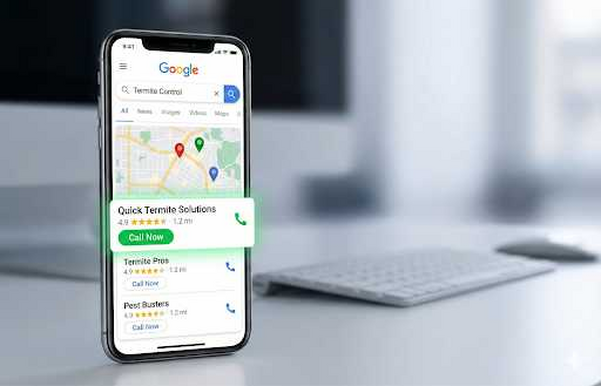
The "Google Map Pack"—that block of three local businesses at the top of the search results—is now your primary source of income. Homeowners searching on mobile devices almost exclusively use the map results because they provide the three things a panicked buyer needs: distance, rating, and availability.
This behavior has turned your Google Business Profile into your most valuable asset. It acts as your digital storefront. Visibility here is a winner-take-all game; the top three listings get the calls, while everyone else gets the leftovers. Smart agencies are shifting focus from tweaking website code to optimizing these map profiles—verifying service areas, adding photos of trucks, and ensuring categories are correct.
2. Speed-to-Lead: Pick Up the Phone or Lose the Job
Here is the hard truth: You can have the best SEO in the world, but if you don't answer the phone, you wasted your money. Marketing agencies are now telling their clients that "operations is marketing." This is the concept of "speed-to-lead."
Data from major sales platforms is precise: HubSpot sales statistics show that if you don't respond to a lead within five minutes, your odds of closing that deal drop off a cliff. In pest control, where the customer is distressed, that window is even tighter. If a homeowner calls and gets voicemail, they don't leave a message. They hang up and call the next guy.
This means your front office needs to be as sharp as your marketing strategy. If your marketing team makes the phone ring, but your operations team misses the call, you are burning cash.
3. Building Trust in Seconds
Because customers are moving so fast, they make snap judgments about your business. Research from BrightLocal shows that 69% of consumers feel more positive about a business when its reviews describe positive experiences. For a pest control owner, this means your online reputation is your resume.
Customers are scanning your reviews for keywords like "on time," "professional," and "safe." They want to know you won't rip them off or track mud into their house. And they look at dates. A 5-star review from 2021 means nothing today. You need a steady stream of fresh feedback.
How Agencies Are Pivoting to "Outcome Metrics"
Good marketing agencies are realizing that the old tricks no longer work. A prime example of this shift was detailed in a recent press release from BlakSheep Creative, an agency that has launched a new service specifically for pest control companies.
This new program moves away from "vanity metrics"—numbers that look good but don't mean anything, like impressions or clicks. Instead, the focus is on "outcome metrics" that actually pay the bills: phone calls, booked inspections, and recurring service plans.
"Pest control marketing only works if it leads to booked jobs," said Clint L. Sanchez, Owner of BlakSheep Creative. "Homeowners make fast decisions when they need help, and Google Maps is often where those decisions start. We built this new service to help pest control companies show up, look like the obvious choice, and turn urgent searches into calls and scheduled work."
The service targets the specific friction points that cause job losses: poor local visibility, lack of trust signals, and slow response paths. By fixing these issues, companies can close the "quiet losses"—customers who found them but moved on because they didn't look credible or didn't respond quickly enough.