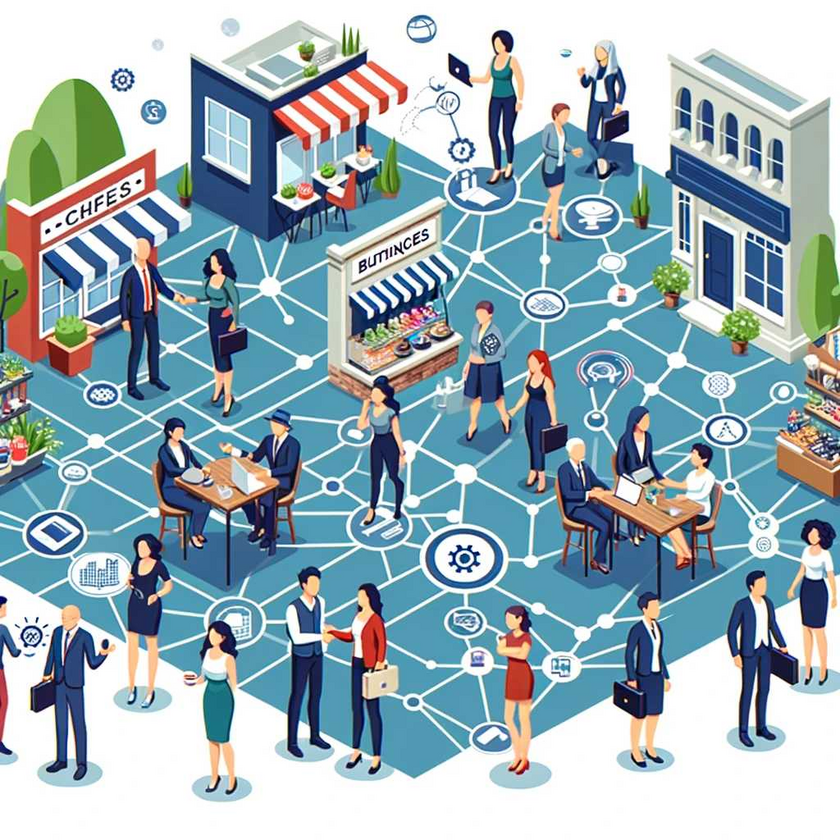
When the average person daydreams about owning a business, the mental image is almost always consumer-facing. We picture a bustling coffee shop, a busy gym, or a fast-food drive-thru with a line wrapping around the building. We think of retail because retail is what we see every day.
But there is a massive, quieter side of the franchising world that operates behind closed doors—and it often comes with better hours, higher margins, and fewer headaches.
The business-to-business (B2B) sector is the engine that keeps other companies running. These franchises don't rely on foot traffic or impulsive teenagers buying smoothies. They rely on professional relationships and contracts with other business owners.
If you are starting your search to buy a franchise, you owe it to yourself to look past the food court. B2B opportunities often offer a top highlight of business ownership: a Monday-through-Friday schedule. No late nights, no holidays, just professional services provided to professional clients.
Here are five sectors within the B2B industry that are currently dominating the market, and why they might be the smarter play for your lifestyle.
1. Commercial Cleaning and Facilities Management
While it isn't the most glamorous industry on paper, commercial cleaning is arguably the most stable. In the post-2020 world, sanitation isn't just a "nice to have" for offices, medical centers, and schools; it is a regulatory and safety requirement.
The beauty of this model lies in the concept of recurring revenue. In a retail food franchise, you start every month at zero. You have to sell a thousand burgers just to match what you did last month. In commercial cleaning, you start the month with a base of signed contracts. If you land a corporate headquarters or a medical park, that client pays you every single month, often for years, as long as you do a good job.
This sector creates a "sticky" income stream. Businesses rarely switch janitorial providers unless something goes terribly wrong, meaning your cost of customer acquisition drops significantly over time while your revenue stacks up.
2. Staffing and Recruiting
The labor market has fundamentally changed. Between employees resigning, the skills gap in trades, and the booming demand for healthcare workers, companies are desperate for talent. They can no longer rely on a simple "Help Wanted" sign in the window.
This is where staffing franchises step in. These businesses act as the external HR department for local companies. Whether it is finding temporary labor for a warehouse or headhunting a C-suite executive for a tech firm, businesses are willing to pay a premium for the right people.
The Scalability: You don't need a massive showroom or expensive equipment. This is a people business.
The Agility: Staffing franchises can pivot quickly. If the construction industry slows down, you can shift your focus to healthcare or administrative placements. You are selling the universal need for human capital, which never goes obsolete.
3. Print, Marketing, and Visual Communications
Even in a digital world, businesses exist in physical space. Every time a new restaurant opens, they need menus, banners, and window decals. Every time a trade show happens, companies need booths, branded polo shirts, and brochures. Every real estate agent needs "For Sale" signs.
Franchises in the print and marketing signage sector have evolved far beyond simple photocopies. They have become full-service marketing agencies for small and medium-sized businesses (SMBs).
The B2B advantage here is the "consultative" sale. You aren't just taking an order for 500 business cards. You are sitting down with a local business owner and helping them solve a visibility problem, and this builds deep loyalty. Once a business trusts you with their brand, they tend to give you all their printing and marketing work, from vehicle wraps to direct mail campaigns. It turns a commodity service into a relationship business.
4. IT Services and Managed Service Providers (MSPs)
Cybersecurity threats used to be a problem only for Fortune 500 companies. Now, the local dentist's office and the neighborhood law firm are terrified of ransomware attacks.
However, a 15-person accounting firm cannot afford to hire a full-time Chief Technology Officer or a dedicated IT security team. This gap has created a massive opportunity for IT services franchises. These companies operate as outsourced IT departments. They handle data backup, software updates, network security, and troubleshooting for a monthly retainer.
The Utility Factor: IT support is now as essential as electricity. A business literally cannot function without its network. This makes IT franchises incredibly recession-resistant.
The Model: Like commercial cleaning, this relies on the Managed Services model—clients pay a fixed monthly fee for peace of mind. It provides a predictable cash flow that allows you to forecast growth accurately.
5. Business Coaching and Consulting
For franchisees coming from a corporate executive background, this is often the most natural transition. Many small business owners are brilliant at their trade—they make great cupcakes or build great cabinets—but they are terrible at business. They struggle with cash flow, leadership, and systems.
Business coaching franchises provide the framework to fix these problems. Unlike other sectors, the inventory here is intellectual property. You don't have to manage a warehouse of rotting vegetables or a fleet of breaking-down trucks. Your "product" is your advice and the franchisor’s proven methodology.
Low Overhead: These can often be run from a home office or a small executive suite.
High Impact: You get the personal satisfaction of saving local businesses. When you help a struggling owner turn their profit margins around, you become a hero in their eyes. The relationships formed in this sector are often the strongest in the entire franchise industry.
Not the Product, But the Customer
Choosing a franchise is about more than just what you sell; it's about who you sell to. Selling to the general public involves high volume, lower transaction values, and the unpredictability of consumer trends. Selling to other businesses involves higher transaction values, contracts, and professional interactions.
If you are looking for a business that allows you to leverage your professional skills while maintaining a schedule that lets you be home for dinner, the B2B sector might be the hidden gem you have been searching for. It proves that you don't need a deep fryer to build a dynasty.